Most Shopify merchants pick one recovery channel and call it done. Either they enable Shopify’s built-in cart abandonment emails, or they install a wishlist app, or they do neither. They almost never run both.
That’s a mistake. The two channels catch different shoppers. Cart recovery catches the almost-bought shopper. Wishlist recovery catches the thinking-about-it shopper. Pick one, and you leave the other group behind.
This post compares both, breaks down where each wins, and explains why running both is the recovery flywheel that actually moves revenue.
Quick answer: Cart abandonment recovers ~10% of shoppers who reached checkout. Wishlist recovery captures shoppers who never added to cart but showed clear intent. The two channels overlap less than 20%, so running both gives you nearly twice the recovery surface area, with no extra cost since both can be set up free.
What each strategy actually catches
The two strategies sound similar but catch different behaviors.
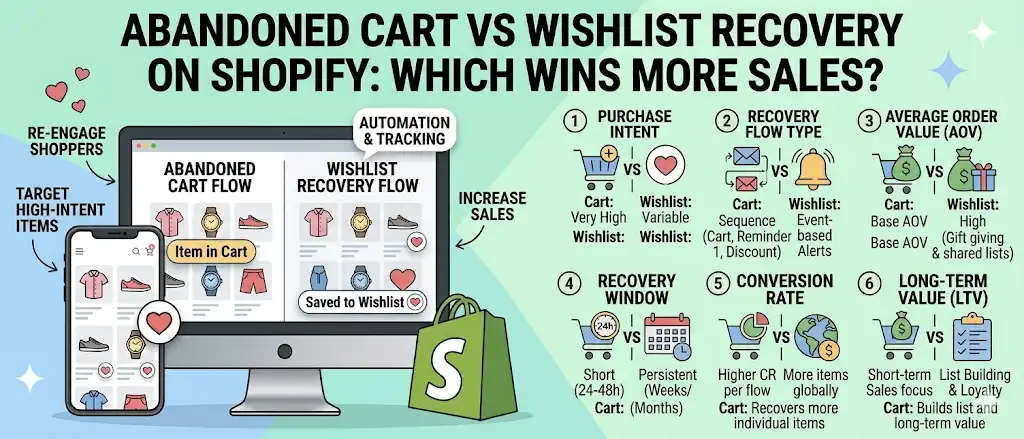
Cart abandonment recovery fires on a specific event: shopper added items to cart, started checkout, then didn’t complete. It needs a real cart and a real email captured at checkout to work. The pool is narrow but high-intent.
Wishlist recovery fires on a different event: shopper saved an item without buying. The save happens before the cart, often before the shopper has decided. The pool is wider. It includes browsers who never would have made it to cart.
A simple way to picture it:
[ Browse ]  →  [ Save ]  →  [ Add to Cart ]  →  [ Checkout ]  →  [ Buy ]
                  ↑                                ↑
                  Wishlist captures here      Cart abandon captures here
If you only run cart recovery, you miss the larger group of shoppers who never added to cart at all. If you only run wishlist recovery, you miss the shoppers who almost completed checkout. Both gaps are revenue.
Conversion rate comparison
These benchmarks come from typical mid-market Shopify performance. Actual numbers vary by industry, AOV, and traffic mix. Treat as ballpark.
| Channel | Recovery rate | What it captures |
|---|---|---|
| Shopify native cart abandonment email | ~7–12% of cart abandoners | High-intent, lost in checkout flow |
| Klaviyo cart abandonment flow | ~10–18% of cart abandoners | Same group, better targeting |
| Wishlist abandonment reminder | ~4–8% of saved items | Mid-intent, didn’t reach cart |
| Wishlist back-in-stock alert | ~15–25% of saved items | Originally couldn’t buy due to stockout |
| Wishlist price drop alert | ~12–20% of saved items | Originally couldn’t buy due to price |
The math is interesting. Cart abandonment has a higher per-event conversion rate, but wishlist generates more events because most shoppers don’t add to cart. The total revenue recovered ends up similar, and that’s before you stack them.
Cost comparison
Both can be set up free on Shopify. But the long-term costs diverge.
Cart abandonment, free version: Shopify’s native cart recovery email is free, included with every plan. It sends one email at 1 hour, 6 hours, or 10 hours after abandonment (you pick). Limited customization. No segmentation.
Cart abandonment, paid version: Klaviyo, Omnisend, or Mailchimp can run multi-step cart abandonment flows with segmentation, A/B testing, and dynamic content. Costs $20–$60/month minimum, scaling up with profile count.
Wishlist recovery, free version: A free wishlist app like Magic Wishlist gives you all four wishlist email types (abandonment, price drop, low stock, back in stock) at no cost, no per-email fee, no profile cap.
Wishlist recovery, paid version: None needed for most stores. The free version covers everything.
Total cost to run both, free: $0/month. The only investment is setup time. About 15 minutes for cart recovery plus 1 minute for wishlist.
Use cases where each strategy wins
Different stores benefit from different mixes.
Cart abandonment wins when
- High AOV: Stores with $200+ orders see massive revenue from each recovered cart. Cart abandonment ROI scales with order value.
- Complex checkout: B2B, customizable products, or multi-step checkouts have high drop-off in checkout itself. Cart recovery emails catch these specifically.
- Mature, repeat-customer base: Shoppers who already trust your brand abandon checkout for transient reasons (distraction, payment issues). A reminder works.
Wishlist recovery wins when
- Multi-visit purchase decisions: Fashion, jewelry, furniture, electronics. Shoppers consider for days. They save before they cart.
- Limited-edition or restock-driven inventory: When products go in and out of stock, back-in-stock alerts crush every other recovery email.
- Gifting / shareable products: Wishlist sharing turns saves into organic referral traffic. Cart abandonment can’t do this.
- Lower AOV with high consideration: Beauty, supplements, accessories. Small order value but long decision cycle.
Both win when
- You have any meaningful traffic to a Shopify store. That’s the honest answer. The two channels overlap less than 20%, so even if your strongest channel is one, the other is incremental revenue at zero ongoing cost.
Stacking both: the recovery flywheel
The right approach for most stores isn’t choosing one. It’s running both, with clear handoffs.
A typical shopper journey now looks like this:
- Shopper browses, saves an item. Wishlist event fires.
- 24 hours later, shopper hasn’t bought. Wishlist abandonment reminder goes out (with a personal discount code).
- Shopper opens email, clicks through, adds to cart. Now they’re in the cart funnel.
- Shopper starts checkout but bails. Cart abandonment email fires (Shopify native or Klaviyo).
- Shopper still hasn’t bought. Wishlist re-engagement nudge at 7 days.
- Three weeks later, item goes on sale. Price drop alert fires.
Same shopper. Six chances to recover. Two channels working in sequence. None of them duplicating each other because each fires on a different event.
This is what a real recovery flywheel looks like. It’s also why “set it and forget it” actually works for ecommerce. The system runs even when you don’t.
Setup guide for both (about 16 minutes total)
Step 1: Enable Shopify’s native cart abandonment email. In your Shopify admin, go to Settings → Checkout → Abandoned checkouts. Turn on automatic emails. Pick the timing (10 hours is the most common). Customize the email if you want. Most stores leave the default and it works fine.
Step 2: Install Magic Wishlist. Go to the Shopify App Store, click Add app. One minute to install and turn on the four built-in wishlist emails. Full setup walkthrough in our wishlist guide.
Step 3: Optional, upgrade cart abandonment to Klaviyo. If you outgrow Shopify’s native email (most stores do around the time they hit $30K/month), connect Klaviyo and build a 3-email cart abandonment flow there. The wishlist app pushes events to Klaviyo too. See the Klaviyo integration guide.
That’s it. Both channels running, both free, both covering different parts of the funnel.
Run both. Free. Forever.
Recovery isn’t a single channel. It’s a stack. Cart abandonment catches the bottom of the funnel. Wishlist catches the middle. Both are free to set up and stay running. The only cost is about 16 minutes of setup.
Install Magic Wishlist free. Remember to switch on Shopify’s native cart abandonment in your settings while you’re there.